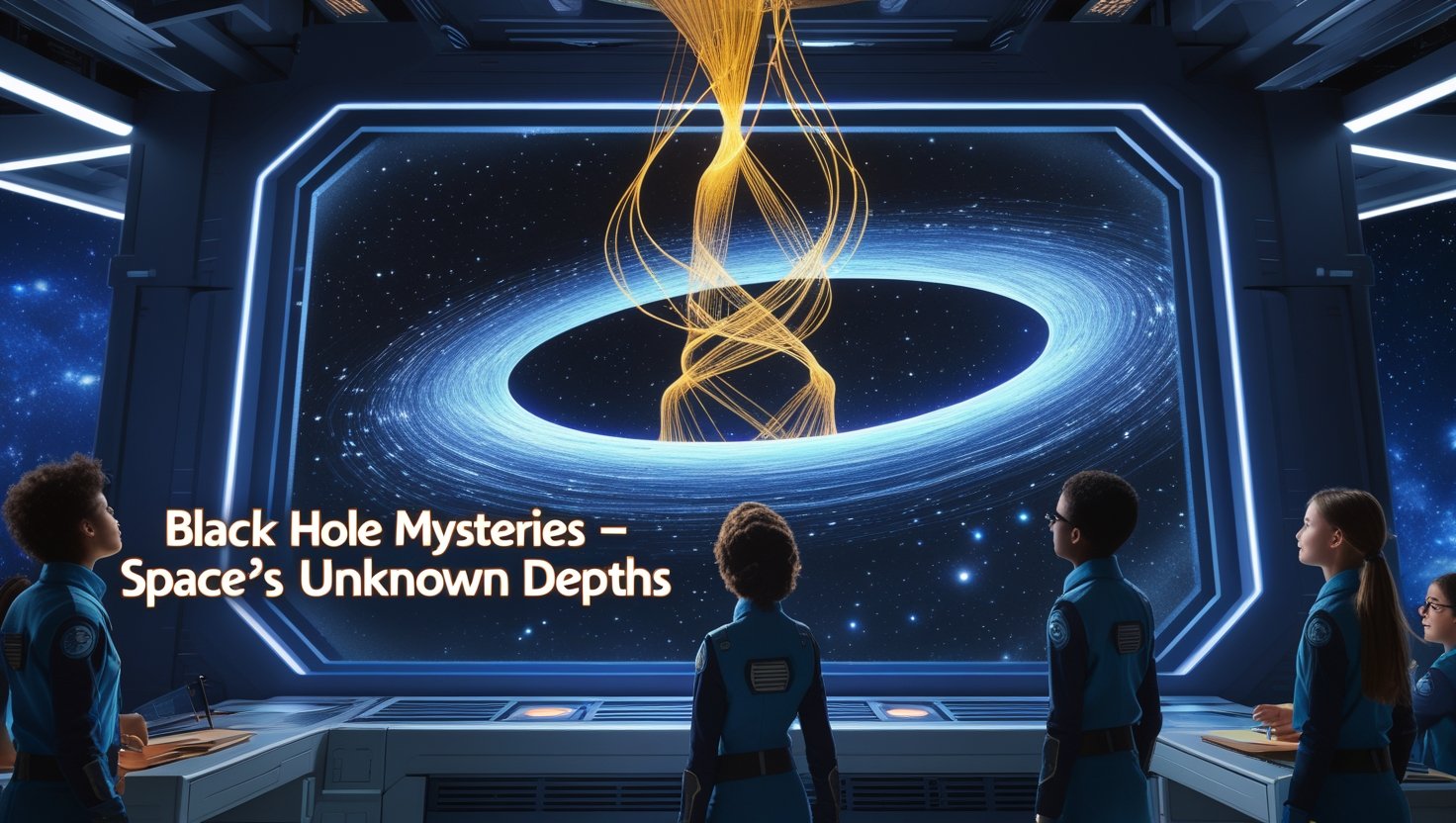
In the vast expanse of the universe, black hole mysteries beckon us to explore space’s unknown depths. These cosmic enigmas defy everyday understanding, challenging our grasp of gravity, time, and matter. With each discovery, black holes reveal hints of secrets that may one day redefine our view of the cosmos.
Gazing Into the Abyss:
Black holes have fascinated astronomers and curious minds alike since the idea was first proposed. Unlike most celestial bodies, black holes are invisible; they are detected by the way their immense gravity affects nearby matter. This invisible force captivates researchers who strive to decipher clues hidden in the distortion of light and the warping of spacetime.
As scientists peer into the heart of these enigmatic objects, every observation fuels new questions about how black holes form, grow, and influence the universe. This innate curiosity forms the basis for one of the most compelling mysteries in modern astrophysics.
Gateway to the Unknown:
At the boundary of every black hole lies the event horizon, a point of no return where gravity becomes irresistible. This edge is more than a physical marker; it is a threshold beyond which our conventional understanding of physics begins to unravel. As objects approach this boundary, intense gravitational forces bend light and stretch time, creating phenomena that challenge even Einstein’s theories.
Researchers study these regions using advanced simulations and observational data from cutting-edge telescopes. The event horizon remains a symbol of the intricate relationship between gravity and light, a constant reminder that our universe holds mysteries far deeper than what meets the eye.
Nature’s Extreme Frontier:
At the very core of a black hole lies the singularity, a point where matter is crushed into an infinitely dense state. The singularity represents the ultimate challenge to our understanding of physics, where the laws we rely on break down completely. According to general relativity, the singularity is the point where all known physical quantities become infinite.
Yet, modern research suggests that quantum forces might prevail in such extreme conditions, hinting at a new theoretical framework yet to be fully developed. As scientists attempt to reconcile gravity with quantum mechanics in these realms, the singularity stands as a testament to the unknown, urging us to explore beyond established theories.
The Whisper of the Abyss:
In a groundbreaking twist on traditional views of black holes, physicist Stephen Hawking proposed that black holes emit a faint glow known as Hawking radiation. This predicted emission of particles occurs as quantum effects near the event horizon allow energy to escape. Although the radiation is incredibly weak for stellar-mass black holes, it provides a crucial insight into how black holes might gradually evaporate over astronomical timescales.
Hawking’s theory not only opened up new avenues in theoretical physics but also helped bridge the gap between quantum mechanics and general relativity. The soft whisper of this radiation has become one of the most intriguing clues in understanding how black holes interact with their surroundings.
The Information Paradox:
One of the most perplexing puzzles in modern astrophysics is the information paradox, which questions what happens to the information contained in matter that falls into a black hole. According to quantum theory, information cannot be destroyed, yet black holes appear to obliterate all observable details about infalling matter.
This paradox has spurred vigorous debate and research, as physicists search for ways to preserve the fundamental principle of information conservation. Various theories, including the idea that information might be encoded on the event horizon or in subtle quantum correlations, have been proposed, yet none offer a complete solution. The information paradox remains a vivid illustration of the unresolved mysteries that black holes continue to present.
Spacetime Distortion and Time Dilation:
Black holes are laboratories for observing some of the most extreme effects predicted by the theory of relativity. As an object nears these cosmic giants, spacetime itself is bent into unfamiliar shapes, leading to phenomena such as time dilation, where time appears to slow down relative to an outside observer.
This effect has been confirmed through satellite experiments and precise astronomical measurements, deepening our understanding of how gravity can warp both space and time. The interplay between these relativistic effects and the immense gravitational pull of black holes not only provides a unique test bed for Einstein’s theories but also exposes the limitations of our current models as we probe deeper into space’s unknown depths.
Unveiling the Invisible:
Recent advancements in observational technology have revolutionized our study of black holes. The launch of sophisticated space telescopes and networks like the Event Horizon Telescope (EHT) has allowed scientists to capture the first direct images of a black hole’s shadow. By analyzing these images, researchers can map the structure of the event horizon and gather data on the dynamics within and around these enigmatic objects.
Alongside gravitational wave detectors, which have recorded collisions between black holes, these tools have provided multiple avenues to test and refine our theoretical models. The synergy between observation and theory continues to unveil the hidden layers of black hole mysteries, gradually peeling back the curtain on the universe’s most obscure phenomena.
Bridging Quantum Physics and Gravity:
At the crossroads of astrophysics and quantum mechanics lies an ambitious quest to forge a unified theory that reconciles the workings of gravity with the behavior of subatomic particles. Black holes, with their extreme environments, are critical arenas for testing these ideas. Various hypotheses, including string theory and loop quantum gravity, suggest that spacetime might have a discrete structure at the smallest scales.
Exploring these theoretical frontiers is not only about understanding black holes but also about pushing the limits of modern physics itself. By investigating how these cosmic titans conform, or deviate, from classical predictions, scientists hope to glean insights that could transform our understanding of the universe at its most fundamental level.
Black Holes as Galactic Architects:
Beyond their individual mysteries, black holes play a vital role in the evolution of galaxies. Supermassive black holes reside at the centers of most galaxies and exert a profound influence on their host systems. These giants regulate star formation, drive energetic jets, and shape the dynamics of the galactic core. Researchers have discovered that the mass of a supermassive black hole is closely linked to the properties of its host galaxy, suggesting a deep and complex relationship.
As stars form, evolve, and die in the vicinity of these cosmic behemoths, they contribute to a dynamic cycle that governs the life and structure of the galaxy. In this way, black hole mysteries are not isolated phenomena but are interwoven with the broader narrative of cosmic evolution.
The Next Chapter in Black Hole Research:
As we advance our understanding of black hole mysteries, the future of space exploration and theoretical physics appears brighter than ever. With planned missions, improved technology, and international collaboration, researchers are poised to answer some of the most pressing questions about these fascinating objects. The next decade promises breakthroughs in detecting finer details of event horizons, understanding particle behavior in extreme gravitational fields, and possibly unlocking the secrets of quantum gravity.
Each step forward propels us closer to a comprehensive theory that not only explains black holes but also illuminates the nature of the universe itself. In the pursuit of knowledge, black holes remain our cosmic signposts, guiding us toward the hidden truths of space’s unknown depths.
Conclusion:
Black holes continue to captivate us as icons of both mystery and discovery. With every observation and theory, we inch closer to understanding the intricate dance of gravity, time, and quantum phenomena. These cosmic enigmas challenge our greatest theories and inspire new ways of thinking about the universe. The journey to unlock their secrets promises to redefine reality as we know it.
FAQs:
Q1. What are black holes?
Extremely dense objects with gravity so strong that not even light can escape.
Q2. What is the event horizon?
The boundary beyond which nothing can return.
Q3. What is a singularity?
A point of infinite density at a black hole’s center.
Q4. What is Hawking radiation?
Theoretical radiation emitted by black holes.
Q5. What is the information paradox?
The puzzle of whether information is lost in black holes.
Q6. How do we observe black holes?
Through indirect effects, gravitational waves, and imaging their shadows.