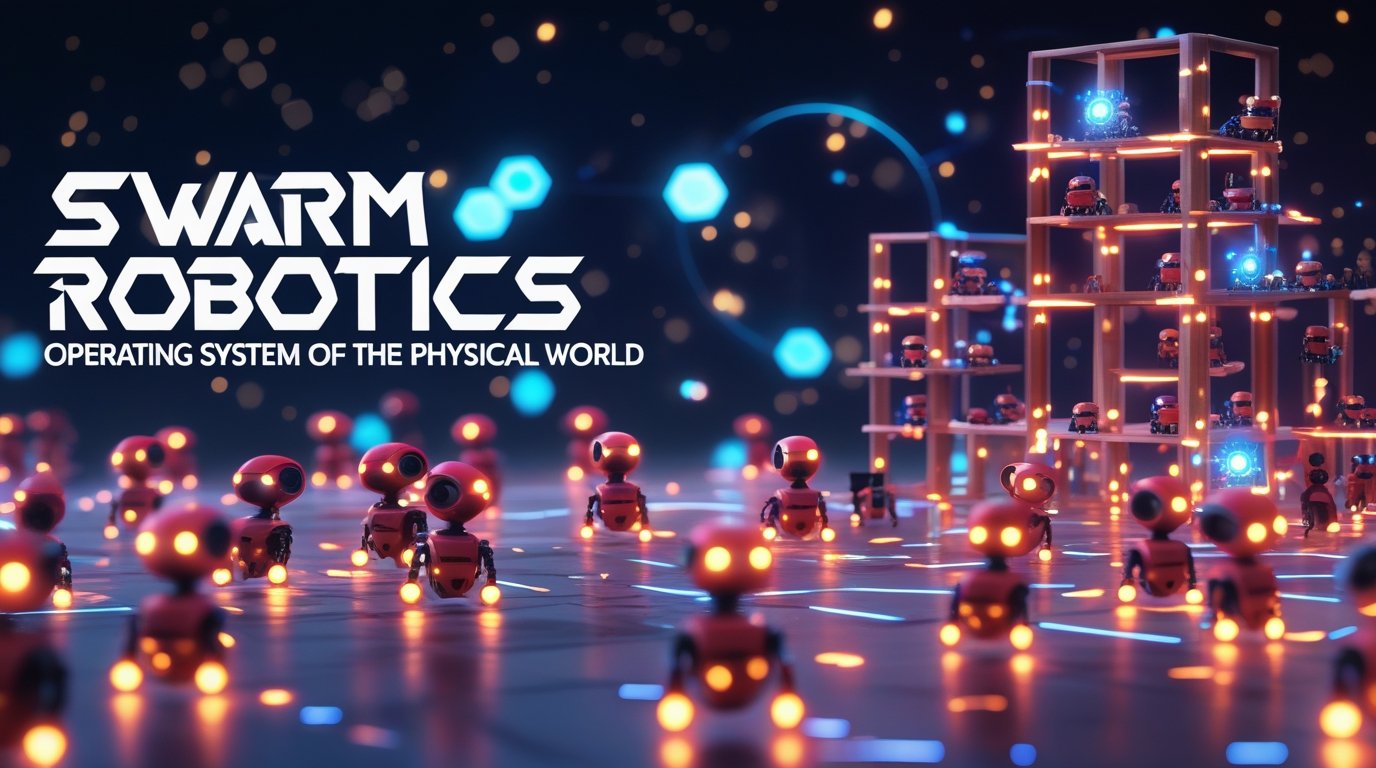
Man, have you ever just… stopped and watched ants? I mean, really watched them? It’s chaos. A complete mess. But somehow, from all that scrambling, they build these insane, complicated colonies. Nobody’s in charge. There’s no ant foreman yelling orders. They just… figure it out. Now, wrap your head around this: what if we could do that with robots? Not big, clunky, expensive ones. I’m talking about a cloud of tiny, simple machines. And by giving them a few stupidly basic rules, they start to behave like a single, brilliant organism. This isn’t just another tech trend. This is something deeper. It’s like we’re learning to write an operating system for reality itself.
Forget What You Know About Robots:
I need you to just wipe the slate clean for a second. When I say “robot,” you probably picture something from a car factory, a huge, powerful, precise arm that does one thing perfectly, over and over. Or maybe you think of a fancy drone with a million sensors.
A swarm robot is the absolute opposite of that. On its own, it’s kind of pathetic. We’re talking about a little clunky thing on wheels or a basic drone frame. It’s got a simple motor, a sensor or two (like a little camera or an infrared sensor to avoid bumping into things), a way to talk to its buddies nearby (like a simple radio blink), and just enough processing power to follow a few instructions. That’s it. It’s not a genius. It’s disposable. If one breaks, you shrug and get another one out of the box. The magic isn’t in any individual unit. The magic is what happens when you get a crowd of them together.
The Secret Sauce:
So how does a bunch of idiots become a genius? It’s not through some advanced AI. It’s through simple rules. We’re talking about the kind of rules you could explain to a kindergartener.
Think of it like this. Your goal is to get the swarm to cover an area evenly. You don’t program a grand plan. You don’t give them a map. You give them three stupidly simple rules:
- Rule 1: Move forward in whatever direction you’re facing.
- Rule 2: If you bump into another robot or a wall, randomly pick a new direction.
- Rule 3: If you don’t see any other robots nearby for a while, make a noise or send a signal to call them over.
That’s. It. You set them loose. At first, it’s pure chaos. They’re bumping around everywhere. But slowly, something incredible happens. They start to spread out. Because of Rule 2, they don’t clump up. Because of Rule 3, they don’t drift too far apart. They naturally, organically, find a way to distribute themselves evenly across the entire available space. No boss robot. No central computer. Just simple rules and local interactions. This is what we call emergent behavior, complex, intelligent patterns arising from simple parts. It’s enough to make your head spin.
Why This Approach is a Total Game-Changer:
This “dumb swarm” idea gives us capabilities that a single fancy robot could never, ever achieve.
- Resilience (The “So What?” Superpower): This is the big one. Let’s say you have a swarm of 100 robots searching a disaster zone. A building collapses. You lose 20 of them. With a single robot, the mission is a catastrophic failure. With a swarm? The mission barely notices. The remaining 80 robots just keep following their rules. The swarm heals itself. There is no single point of failure. You can’t stop a swarm; you can only hope to contain it.
- Scalability (The “More the Merrier” Superpower): Need to search a bigger area? Just pour more robots out of the box. The rules don’t change. The system doesn’t get overwhelmed. It just works. Ten robots or ten thousand, the principle is identical. It’s naturally, effortlessly scalable.
- Flexibility (The “Roll With It” Superpower): The swarm doesn’t need a pre-programmed map. If an obstacle appears, the robots on the edge bump into it, change direction, and the whole swarm flows around it like water. It adapts in real-time to a changing environment without needing to be told. It’s inherently flexible.
No, Really, This is Happening Now:
This isn’t just lab stuff anymore. This is moving into the real world in ways that are honestly stunning.
- Search and Rescue: This is the example that gives me chills. After an earthquake, instead of sending a single expensive drone that might crash, first responders could release a thousand tiny flying or crawling robots into the rubble. Their simple rule: “Spread out and report back if you detect heat or motion.” They’d seep into every crack and void. They’re so small and cheap, losing hundreds is an acceptable cost if they find even one survivor.
- Farming (The Quiet Revolution): Imagine a field. Instead of one giant tractor spraying herbicide over everything (weeds and crops alike), a swarm of small, solar-powered rover bots trundles through the rows. Their rule: “Use your camera to identify a weed. Spray only the weed.” The swarm fans out. Each robot makes a simple “green thing, good? green thing, bad?” decision. The result? A 95%+ reduction in chemicals, healthier soil, and higher yields. It’s a total paradigm shift.
- Construction (This Feels Like Magic): Think of a swarm of drones building a brick wall. Their rule: “Pick up a brick, fly to the growing structure, and place your brick next to an already-placed brick.” You feed the overall design into the swarm’s shared rule set, and they collectively build it. They could work 24/7, building structures with curves and shapes that are impossible with traditional scaffolding. They could even repair bridges or buildings by swarming over the surface.
- Medicine (The Final Frontier): This is the real sci-fi stuff. Researchers are working on microscopic swarms. Think of injecting a cloud of tiny robots into your bloodstream. Their rule: “Find cells with this specific signature (cancer cells) and attach to them.” They could deliver drugs with pinpoint accuracy, zapping diseased cells without harming a single healthy one. It would revolutionize treatment.
The Weird and Worrying Stuff:
A power-up this big doesn’t come without some serious questions. It’s not all cool demos and happy farmers.
The biggest issue is control. How do you stop a swarm? How do you recall it? If your rule is “spread out and search,” what stops the swarm from just… keeping going? You need a universal “off” switch or a “return home” rule that every single unit understands instantly and perfectly. Get that wrong, and you have a problem.
Then there’s liability. If a construction swarm drops a beam, who is to blame? The engineer who wrote the rules? The company that made the bots? The user who deployed them? Our legal systems are built on the idea of a single point of failure, which a swarm deliberately eliminates.
And yeah, of course, the military is all over this. The potential for distributed surveillance, disruption, and yes, offensive capabilities, is massive and deeply unsettling. The ethical conversation around this needs to happen now, not after the fact.
A Whole New Way of Thinking:
For me, the coolest part of swarm robotics isn’t even the robots. It’s the mental shift. We’re so locked into a top-down way of thinking. A boss gives orders. A computer runs a program.
Swarm robotics is the opposite. It’s bottom-up. It’s decentralized. It’s about setting the stage with simple rules and then letting the complexity emerge on its own. It’s a humbling reminder that you don’t always need a grand plan or a brilliant leader to create order and get things done. Sometimes, you just need a good set of rules and the courage to let go of control.
Wrapping Up:
So next time you see a flock of starlings twisting in the sky or a colony of ants building a nest, don’t just see animals. See the world’s most elegant, tested, and powerful operating system. They’ve been running on this software for millions of years. We’re just finally learning how to code for it. Swarm robotics isn’t about building better machines. It’s about learning to speak the physical world’s language.
FAQs:
1. What’s the main difference between a robot swarm and a single advanced robot?
A single robot is a fragile genius; a swarm is a robust crowd of simpletons that gets the job done even when lots of them break.
2. Does a robot swarm need an internet connection to work?
Nope, they typically use very basic, local chatter like Bluetooth or infrared to just talk to their immediate neighbors.
3. Is complex artificial intelligence needed for swarm robotics?
Not usually—it’s far more about simple, pre-programmed rules than any kind of deep learning, though that’s starting to change on the edges.
4. What’s the biggest practical hurdle right now?
Figuring out how to manage power and recharge thousands of these things without it becoming a full-time job for someone.
5. Could a swarm become conscious and turn on us?
That’s pure science fiction; the reality is we’d mess up the rules long before any consciousness emerged, causing far more mundane failures.
6. When will I see this in my daily life?
You’ll see it in industry and agriculture within a few years, but a swarm of robots doing your household chores is still a long way off.